
The importance of oscillation is something I don’t think I need to justify, especially considering how we’ve spent an entire series of videos just dedicated to the exploration of a physical system specifically concerned with that kind of movement.
As such we will start this article with the assumption that oscillation is needed in mind, the only question remaining being “What kind of oscillation?”
Yes, if you went in expecting a simple lecture on trigonometric functions, allow me to remind you that you’re reading an article written by MAKiT, so an instant curveball is to be expected, and as such, I will give you three examples of oscillation already.



Now these three kinds of oscillation may seem… weird. Unnatural. Alien.
But why?
What even is oscillation?
We will define oscillation as following:
This is our own definition of course, but I do believe it captures the idea of oscillation, and we can rewrite it in the following equation:
And with that equation our only requirement is for our wave to go back to the same spot every period, which can be showcased with this cube, which position is going back and forth.

This would be an example of the “abstract value” in our definition being position, and the “degree of freedom” being time.
But we can be a tad more abstract, and we can just change our abstract value to brightness instead
 This results in our cube cube changing brightness, but it’s not the end of our power, we can also change the degree of freedom from time to position

In this scenario it may not seem like this does result in oscillation, but if I move the cube consistently in position, you can see how the brightness is oscillating.

So importantly, if we want a more generalised notion of oscillation, we need to instead imagine it as a graph like this

Which we can conveniently cut to a single period, since if we know the first period, we know the entire function (it’s periodic)
With that in mind, we have a neat graph, but we’re still nowhere closer to finding out the mystery of the original waves… so, how can we improve our intuition of these waves?
Well, first we can do it by changing our view, instead of thinking about us following this graph in terms of following the degree of freedom

Let’s think about it in terms of the graph being our path, and us following the distance along that path

Now this may seem like an utterly useless exercise, they both result in the same idea, and it is useless, that is, until you realise that this subtle change allows us to completely disregard the distance in the degree of freedom.
Since our only constraint is distance along the path, and the path repeats, instead of thinking about it in terms of following this graph, we can think about it in terms of tracing a shape, so our entire infinite, forever repeating function gets squished into a single jpeg… that’s really convenient
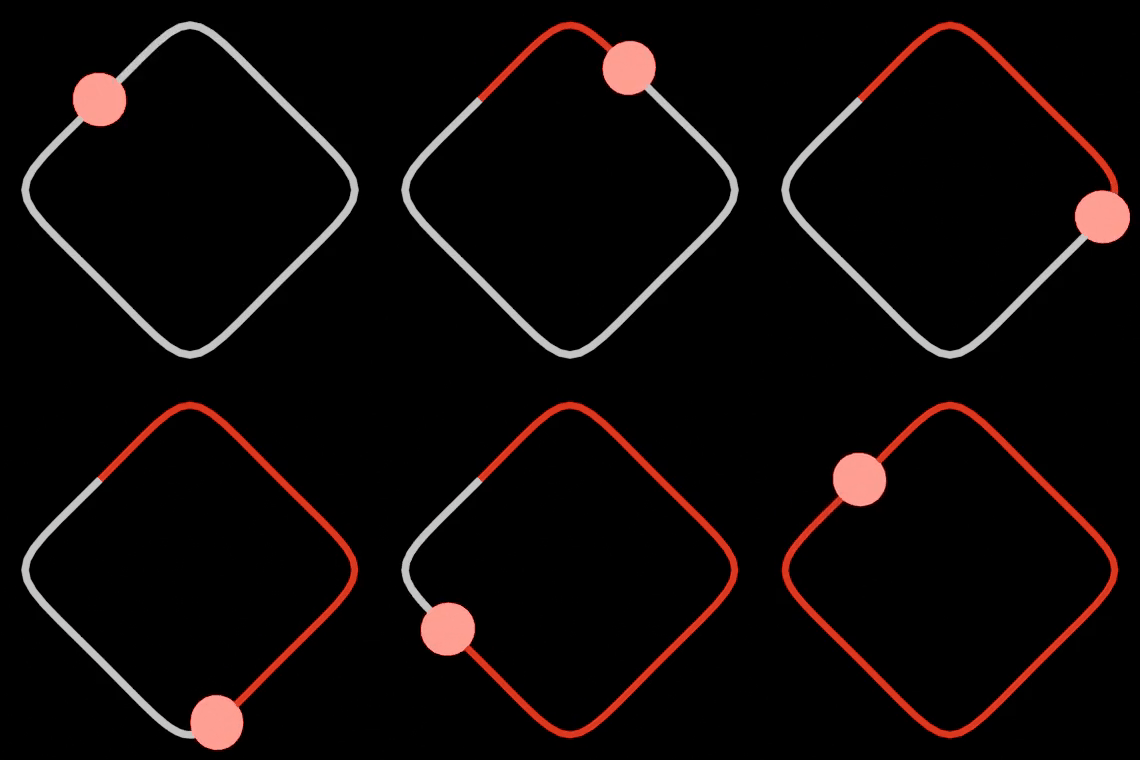
But it gets even better, since with very little effort we can trace these oscillations based on shapes as follows…
And very crucially, this shows us two things.
First of all, every shape we can loop over like so can be just defined as two different waves, the shape-wave and the co-shape-wave, allowing us to describe the shape in terms of oscillations.
And secondly, for the circle, those waves just happen to be sine and cosine, allowing us to follow the trend of the video to get… an equation describing the circle
Which just happens to be the point of the video I've released on rotations
The interesting thing we've discovered today however is in the fact that this imaginary exponential isn't the inherent form of oscilations, rather, it is the natural relation of oscillations specifically following the pattern of a circle, meaning that not only with a different shape we'd get a different function, but also when talking about rotations, sine and cosine are a very natural ways to break down this rotation.
As a footnote I will also add that there are certain points at which it’s useful to talk about a more general notion of oscillation, which requires a more general definition of:
such that
It is up to the reader of this article to figure out when such a notion is needed and desired